
One of the most counterintuitive facts about crypto security is that a wallet can show you exactly what a transaction is expected to do and still leave the final decision entirely in your hands. That is not a contradiction; it is the defining boundary of self-custody. For German-speaking DeFi users, the question behind “Rabby installieren” is therefore not simply whether Rabby is faster or more convenient than another browser wallet. The more useful question is whether its design helps you understand an increasingly complex transaction before you sign it.
Rabby was developed as a non-custodial wallet for Ethereum and other EVM-compatible networks, with a strong emphasis on multi-chain DeFi. It supports more than 140 EVM networks, including Ethereum, Polygon, Arbitrum, Optimism, Avalanche, Base and BNB Chain. That breadth matters because the main operational risk in multi-chain activity is often not a dramatic protocol failure, but a small misunderstanding: the wrong network, an excessive token approval, an unfamiliar contract, or a bridge route whose consequences are difficult to see in advance.
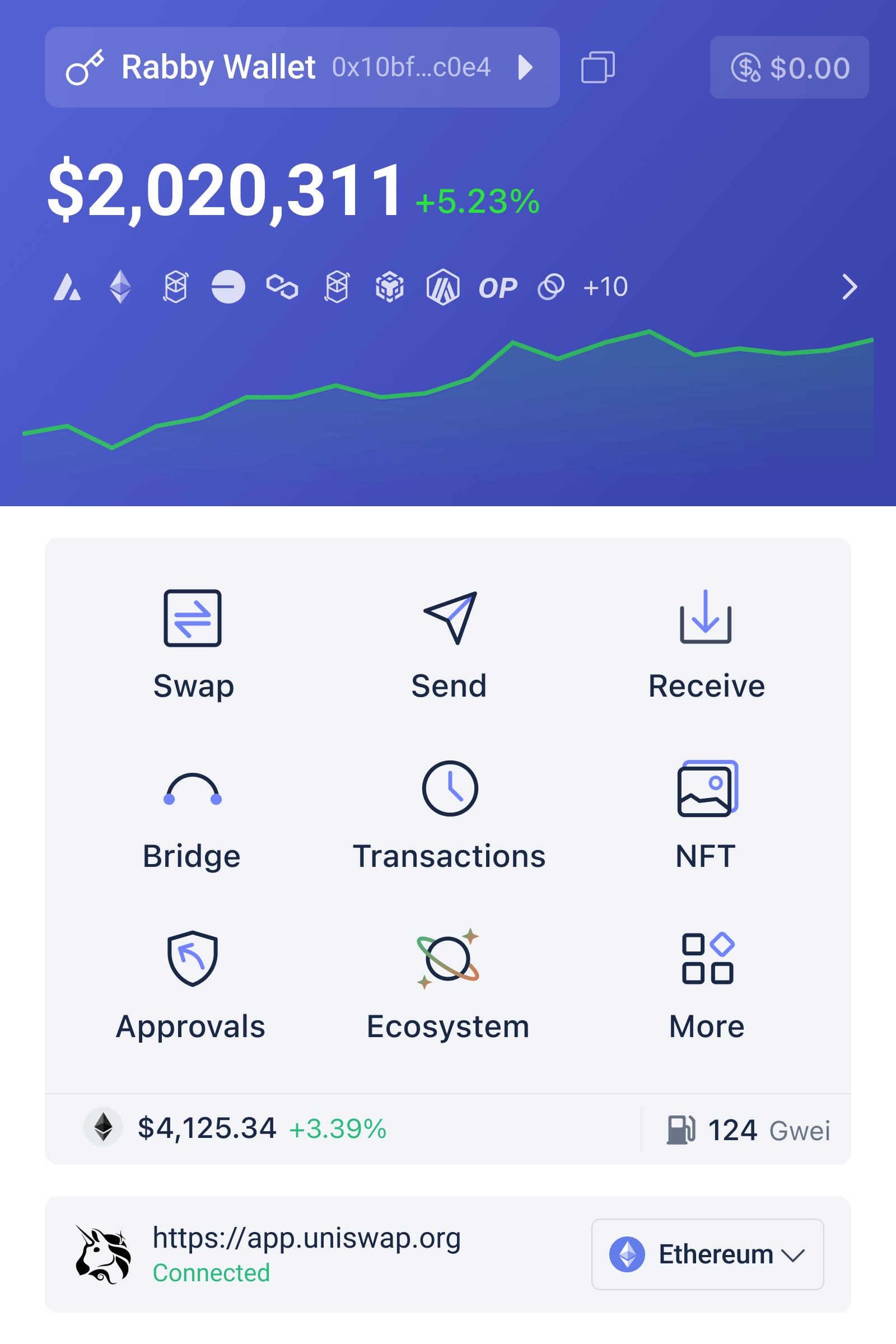
The first myth: a wallet is not a vault with automatic judgment
Rabby’s central security idea is transaction simulation. Before signing, the wallet attempts to display the expected changes to token balances and other relevant outcomes. In practical terms, this changes the user’s mental model from “approve this technical call” to “check what leaves my wallet and what should arrive.” That is a meaningful improvement, especially when interacting with decentralised applications whose interfaces can conceal complex smart-contract operations.
Yet simulation is an analysis tool, not an insurance policy. It depends on the available information, the state of the network, and the behaviour of the contracts involved. A malicious or defective contract may still exploit conditions that are difficult to model, and a user can still approve a transaction after receiving a warning. Simulation also cannot transform an unsafe website into a safe one. It makes consequences more legible; it does not remove the need to verify the dApp, the contract address, the requested permissions and the economic logic of the action.
This distinction corrects a common misconception. Security warnings are not proof that an interaction is safe, while the absence of a warning is not proof that it is risk-free. A sensible interpretation is probabilistic: warnings can identify known or detectable risk signals, such as phishing patterns, suspected hacks, suspicious addresses or potentially unlimited token approvals. They reduce avoidable mistakes, but they cannot establish the future honesty of a protocol or guarantee that a new contract contains no vulnerability.
Why Rabby became relevant as DeFi moved beyond one chain
Early browser wallets were often used as simple gateways to Ethereum applications. As scaling networks, sidechains and alternative EVM chains expanded, the user experience became more fragmented. Network selection, gas management and token discovery all introduced opportunities for error. Rabby addresses this particular form of complexity by recognising the network required by a connected dApp and switching to it automatically. That removes a repetitive manual step, although users should still confirm that the application is asking them to operate on the intended chain.
The convenience is most visible in workflows that cross several systems. Rabby integrates bridge functionality through services such as LI.FI, and its swap interface can compare routes associated with decentralised exchanges such as Uniswap and 1inch. An aggregator may improve route selection or reduce the effort needed to compare prices, but “best rate” is never the same as “lowest total risk.” Slippage, bridge security, execution assumptions, liquidity and smart-contract exposure remain relevant. A cheaper route can carry a different risk profile from a more expensive but simpler one.
The Gas Account feature illustrates another trade-off. It can allow users to pay network fees with stablecoins such as USDC across supported networks, which is useful when a wallet holds assets but lacks the native token required for gas. This lowers a familiar barrier for newcomers and makes multi-chain activity more practical. It also introduces another service mechanism to understand: the user should know how the conversion, account funding and fee settlement work rather than treating stablecoin gas as costless or universally available.
How to approach “Rabby installieren” safely
Installation is part of the security model, not an administrative detail. A browser extension controls access to signing prompts and should be obtained only through a source the user has independently verified. Check the domain carefully, avoid sponsored search results that imitate official pages, and compare the extension’s publisher information and permissions before proceeding. Rabby is primarily available as a browser extension for Chrome, Brave and Edge, with desktop versions for Windows and macOS and mobile applications for iOS and Android.
During setup, the recovery phrase is the decisive security boundary. Rabby follows a non-custodial model: private keys are stored locally on the user’s device rather than being sent to Rabby’s servers. This means the provider cannot simply reset access if the phrase is lost. The phrase should be created or imported in a controlled environment, written down offline, and never entered into a website, chat, form or support conversation. A wallet that does not hold your keys cannot protect you from disclosure of the recovery phrase.
For meaningful holdings, hardware-wallet compatibility with Ledger, Trezor and OneKey offers an additional separation between browsing and signing. The browser can prepare and display a transaction, while the hardware device provides a separate signing boundary. This is not friction for its own sake. It is a response to the fact that browser environments are exposed to extensions, malicious sites and user-interface deception. Hardware signing still requires careful verification, but it can reduce the consequences of a compromised computer.
Open source, independence and the limits of trust
Rabby’s software is published as open source under the MIT licence, enabling community members to inspect and reuse the code. Open source improves auditability, but it should not be confused with a universal security certificate. Code review is valuable only when the relevant code is examined, maintained and understood; users also interact with external dApps, bridges, RPC providers, browsers and operating systems. The wallet is one layer in a larger chain of dependencies.
Another useful distinction concerns Rabby’s backend. Rabby does not independently create or alter transactions on the user’s behalf; it functions as an interface and an independent checking layer. Core signing functions can remain usable offline if Rabby’s servers are unavailable. That is a meaningful resilience property, but it does not make the entire DeFi experience independent of infrastructure. Network access, blockchain availability, RPC data and the application being used may still affect what can be prepared, simulated or executed.
A practical decision framework follows from these boundaries. Before signing, ask four questions: Is this the correct dApp and network? Does the simulated balance change match my intention? Am I granting a narrowly scoped approval or an unlimited one? What external system—protocol, bridge, aggregator or fee service—am I trusting? These questions remain useful whether the transaction is a swap, a liquidity deposit, a bridge transfer or a simple token approval.
What to watch as multi-chain wallets mature
Recent project messaging presents Rabby as a broad wallet for Ethereum and EVM activity, rather than merely another account manager. The direction is understandable: as users move between rollups, sidechains and application-specific environments, the competitive question becomes whether a wallet can compress complexity without hiding it. Automatic network switching, simulations, hardware support and stablecoin-based gas payments all point toward that goal.
The unresolved issue is whether convenience will keep pace with risk. More integrated features can reduce operational mistakes, but they also create a larger interface through which users may access swaps, bridges, fee accounts and loyalty features such as Rabby Points. If adoption grows, the quality of warnings, the transparency of route selection and the user’s ability to distinguish wallet functionality from third-party protocol risk will matter more than a simple feature count. The likely lesson is conditional: better interfaces can improve safety when they expose assumptions clearly, but they can increase overconfidence when they make complexity feel absent.
FAQ: Rabby browser wallet and DeFi security
Is Rabby a custodial wallet?
No. Rabby is designed as a non-custodial wallet, and private keys are stored locally on the user’s device. Control and responsibility therefore remain with the user. Losing the recovery phrase or exposing it to another party can mean losing access, regardless of the wallet interface.
Does transaction simulation guarantee that a transaction is safe?
No. Simulation can make expected token and asset changes easier to inspect and can reveal warning signals, but it cannot guarantee that a contract is secure, that a website is authentic, or that future protocol behaviour will be benign. Treat it as a decision aid, not as a substitute for verification.
Can Rabby replace a hardware wallet?
For small experimental balances, some users may rely on a browser wallet alone. For larger or long-term holdings, hardware-wallet integration can provide a stronger signing boundary. Rabby and a hardware wallet serve different roles: Rabby helps present and analyse the transaction, while the hardware device protects the signing process.
Where should a new user begin?
Begin with the verified installation source for the rabby wallet, create or import the wallet in a private setting, protect the recovery phrase offline, and test with a small amount. Before every unfamiliar interaction, compare the intended action with the simulated result and review approvals rather than signing automatically.

No comment